Showing posts with label bacteria. Show all posts

Wednesday, April 28, 2010

Teeth

Posted by P.SURESH BABU at 3:57 AM 0 comments

Teeth

The teeth are hard, bonelike structures found in the mouths of most vertebrates. They are made to cut, tear or crush food so that it can be swallowed. Cutting teeth are called incisors, tearing teeth are called canines and the crushing teeth are called pre-molars and. molars. Meat-eating animals have large canines for tearing flesh. Plant-eaters have sharp incisors and large molars for snapping off and grinding stringy stalks. Humans have all the three kinds of teeth because we eat all kinds of food.

Human beings get two sets of teeth during their life time - primary teeth and permanent teeth. Primary teeth are also called deciduous or milk teeth. There are 10 on top and 10 on the bottom. As one grows, these teeth become loose and fall out. They are replaced by a permanent set of 32 teeth. There are three layers in a tooth. At the centre is a space full of nerves and blood vessels called 'pulp cavity'. Around it there is a bony wall of 'dentine'. On top of it is a layer of hard, shiny 'enamel'. There are two parts of a tooth. The part of the tooth that you can see above the gum is called the 'crown'. Below the gum is the root of the tooth. The root is fixed in the jawbone by a layer of bone called cement.

Frequent and excess eating of sugar and sweets is not conducive for healthy teeth. Bits of sugar stay around your teeth, no matter how much you chew. Bacteria are always present in your mouth, and they act on the sugar to produce an acid. This acid attacks the enamel and in time makes cavities in your teeth. Very cold and hot drinks are also harmful for teeth. We get tooth decay if we allow too much damage to the tooth by eating-sweets in excess and by not brushing our teeth regularly.

Allergies

Posted by P.SURESH BABU at 3:34 AM 0 comments


An allergy is any condition in which a person reacts in a hyper­sensitive or unusual manner to any substance or agent. The range of allergies is very broad and people may react to various foods, drugs, dusts, pollens, fabrics, plants, bacteria, animals, heat, sunlight and many other things. Whenever a foreign material invades the tissues, the body reacts to fight against it. The body produces certain materials called antibodies which combine with the foreign material and render it harmless. But should it enter the body a second time, the antibodies are torn away from the body tissues to attack the substance. This causes a chemical substance called histamine to be released, which in turn produce the disorders which are symptoms of an allergy.

In spring and early summer some people suffer from an allergic reaction to certain plants and pollens. This is called hay fever and can give the symptoms of a heavy cold.

Showing posts with label bacteria. Show all posts

Wednesday, April 28, 2010

Teeth


Teeth

The teeth are hard, bonelike structures found in the mouths of most vertebrates. They are made to cut, tear or crush food so that it can be swallowed. Cutting teeth are called incisors, tearing teeth are called canines and the crushing teeth are called pre-molars and. molars. Meat-eating animals have large canines for tearing flesh. Plant-eaters have sharp incisors and large molars for snapping off and grinding stringy stalks. Humans have all the three kinds of teeth because we eat all kinds of food.

Human beings get two sets of teeth during their life time - primary teeth and permanent teeth. Primary teeth are also called deciduous or milk teeth. There are 10 on top and 10 on the bottom. As one grows, these teeth become loose and fall out. They are replaced by a permanent set of 32 teeth. There are three layers in a tooth. At the centre is a space full of nerves and blood vessels called 'pulp cavity'. Around it there is a bony wall of 'dentine'. On top of it is a layer of hard, shiny 'enamel'. There are two parts of a tooth. The part of the tooth that you can see above the gum is called the 'crown'. Below the gum is the root of the tooth. The root is fixed in the jawbone by a layer of bone called cement.

Frequent and excess eating of sugar and sweets is not conducive for healthy teeth. Bits of sugar stay around your teeth, no matter how much you chew. Bacteria are always present in your mouth, and they act on the sugar to produce an acid. This acid attacks the enamel and in time makes cavities in your teeth. Very cold and hot drinks are also harmful for teeth. We get tooth decay if we allow too much damage to the tooth by eating-sweets in excess and by not brushing our teeth regularly.
Allergies


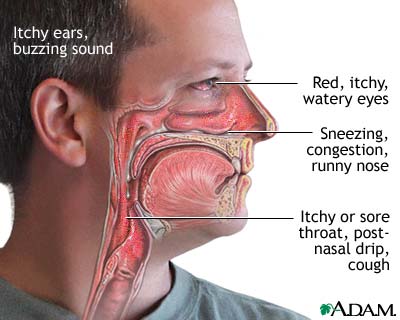
An allergy is any condition in which a person reacts in a hyper­sensitive or unusual manner to any substance or agent. The range of allergies is very broad and people may react to various foods, drugs, dusts, pollens, fabrics, plants, bacteria, animals, heat, sunlight and many other things. Whenever a foreign material invades the tissues, the body reacts to fight against it. The body produces certain materials called antibodies which combine with the foreign material and render it harmless. But should it enter the body a second time, the antibodies are torn away from the body tissues to attack the substance. This causes a chemical substance called histamine to be released, which in turn produce the disorders which are symptoms of an allergy.

In spring and early summer some people suffer from an allergic reaction to certain plants and pollens. This is called hay fever and can give the symptoms of a heavy cold.


INFINITE INFO Copyright 2009 Reflection Designed by Ipiet Templates Image by Tadpole's Notez | Blogger Template | Blogger Templates | Distributed by Blogger